 Tecnon Smart Display - Professional LED Display Manufacturer Logo
 Smart cities, retail chains, transport hubs, and brands now operate across many locations at once. In this environment, Smart LED displays play a new role. They no longer work as isolated screens. They act as connected communication tools that share the same message, data, and timing—no matter where they are installed.
Real-time synchronization turns separate displays into one coordinated network. This shift changes how organizations manage content, respond to events, and deliver consistent visual experiences.
Why Smart LED Displays Need Real-Time Synchronization
In the past, each LED screen worked on its own schedule. Teams updated content manually, often with delays and errors. Today, that approach no longer works.
With LED screen, synchronization solves three major challenges:
- Consistency: Every location shows the same message at the same time
- Speed: Updates happen instantly, not hours or days later
- Control: Central teams manage thousands of screens from one platform
This is critical for live promotions, public safety alerts, traffic guidance, and brand campaigns.
How Smart LED Displays Achieve Real-Time Synchronization
Cloud-Based Content Management
Most LED panel connect to cloud control systems. These platforms push content to all screens at once. Operators schedule playback, trigger instant updates, or run time-based campaigns.
Because everything runs online, location no longer matters. A display in a mall, airport, or city square updates at the same moment.
Edge Controllers and Local Caching
To prevent delays, modern LED systems use local controllers. These devices cache content on-site. If the network slows or drops, playback continues smoothly.
This setup keeps LED screens stable, even in busy environments like transport hubs or outdoor public spaces.
Use Cases That Depend on Synchronized Smart LED Displays
Retail Chains and Brand Campaigns
Retail brands rely on timing. A product launch loses impact if screens update at different times.
With synchronized LED displays, brands can:
- Launch promotions nationwide in seconds
- Align in-store visuals with online campaigns
- Adjust pricing or messaging instantly
This creates a unified brand experience across all locations.
Transportation and Traffic Management
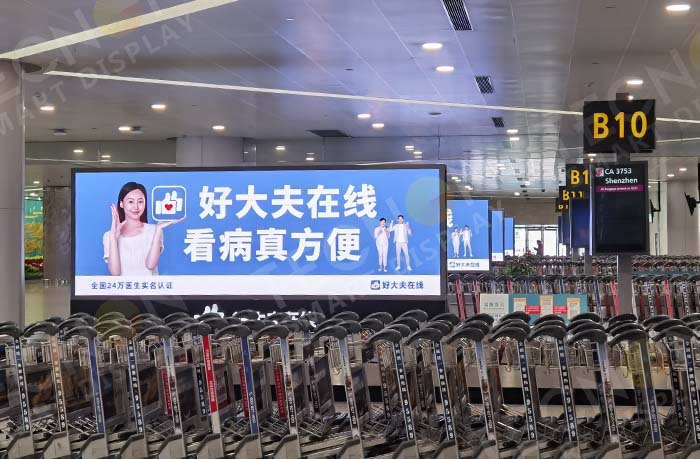
Airports, metro systems, and highways use Smart LED displays for live information. Delays, route changes, or safety alerts must appear everywhere at once.
Synchronization ensures passengers see the same message on platform screens, hall displays, and roadside boards—without confusion.
Smart Cities and Public Communication
Cities use connected LED systems for:
- Emergency alerts
- Weather warnings
- Event guidance
- Crowd management
When displays synchronize in real time, cities respond faster and communicate clearly with the public.

Technical Challenges Behind Synchronization
Network Latency
Large LED networks depend on stable connectivity. Even small delays can break synchronization. Advanced systems reduce this risk through time-stamping and playback buffering.
Screen Diversity
Different locations often use different sizes, pixel pitches, or aspect ratios. LED screens solve this with adaptive content scaling. One design fits many screens without distortion.
System Security
When screens connect to the internet, security matters. Modern platforms protect LED screen with encrypted connections and permission controls to prevent unauthorized access.
Why Smart LED Displays Are Different from Traditional LED Screens
Traditional LED screens show content. Smart LED displays manage data.
They integrate with:
- IoT sensors
- Traffic systems
- Retail POS platforms
- Environmental monitoring tools
This allows displays to react automatically. A traffic screen updates based on congestion. A retail display changes content based on foot traffic. Synchronization makes these responses visible everywhere at once.
Business Benefits of Real-Time LED Synchronization
Organizations that deploy synchronized LED displays gain clear advantages:
- Lower operational cost through centralized control
- Faster response time during emergencies or campaigns
- Stronger visual impact across multiple locations
- Better data-driven decisions using live analytics
Instead of managing screens one by one, teams operate a single visual network.
What to Consider Before Deploying Synchronized LED Screens
Before scaling up, organizations should evaluate:
- Network stability at each location
- Software compatibility across screens
- Content workflow and approval process
- Long-term maintenance and support
Choosing the right system at the start prevents future complexity.
The Future of Smart LED Display Synchronization
As 5G and edge computing expand, synchronization will become faster and more precise. Smart LED screens will react in real time to data streams, user behavior, and city systems.
Screens will no longer just display information. They will become live interfaces for connected environments.
Conclusion: One Message, Many Locations, Perfect Timing
Real-time synchronization transforms LED screen into powerful communication networks. It helps brands stay consistent, cities stay responsive, and operators stay in control.
If you are planning a multi-location LED project or upgrading an existing system, synchronization should not be an afterthought. It should be the foundation.
Contact us to explore how Smart LED displays can work together—perfectly timed, perfectly controlled, and ready for real-world demands.